 Sat, May 30, 2026 12:50 AM
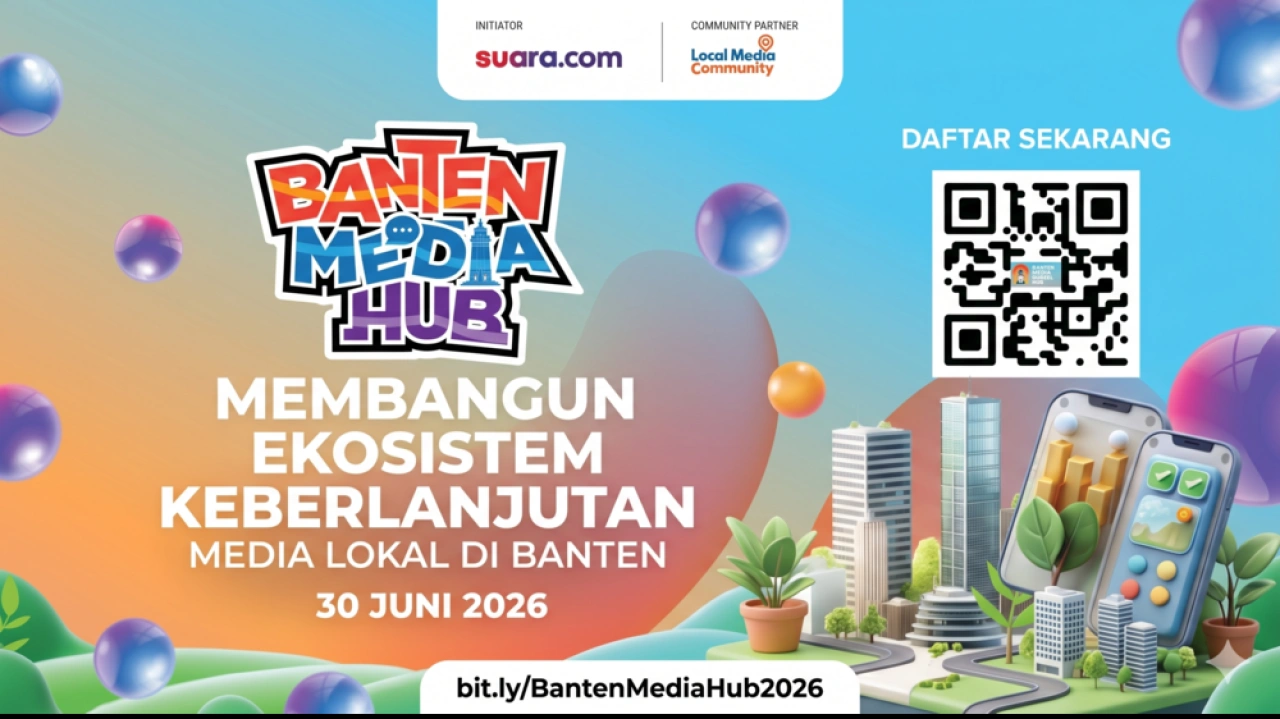
Local media continues to play a crucial role as a pillar of information and democracy at the regional level. To strengthen this role, Suara.com, in collaboration with the Local Media Community (LMC), will soon host the Banten Media Hub 2026. With the overarching theme "Building a Sustainable Local Media Ecosystem in Banten," the event is scheduled for June 30, 2026, in Serang City.
Suara.com's Editor-in-Chief, Suwarjono, stated that amidst massive digital disruption, local media face significant challenges related to business sustainability and financial independence. He emphasized that the main challenges facing local media today include business sustainability, the increasingly massive shift in audiences to social media, and the urgency of delivering high-quality, impactful content.
"Therefore, Banten Media Hub 2026 serves as a strategic consolidation space aimed at building a supportive ecosystem for local media resilience through business model innovation, technological adaptation, and audience expansion," he explained.
This program is designed to ensure that local media outlets not only survive but also thrive and contribute significantly to achieving the Sustainable Development Goals (SDGs) in their operational areas. Overall, this series of events has three main objectives: promoting economic independence through revenue diversification strategies, strengthening cross-sector collaboration, and increasing innovation in solution-oriented content related to SDG issues.
Participants in this event are designed to be inclusive, embracing two key pillars of information dissemination in the digital era: website-based local media outlets and homeless media entities operating entirely through social media platforms. The involvement of these two groups is based on the understanding that the landscape of information dissemination at the regional level has undergone a radical shift, with today's audience consuming news from a variety of highly dynamic channels.
This step of involving homeless media outlets is specifically taken to ensure a healthier digital public information ecosystem in Banten, free from hoaxes and misinformation, as the media are business-sound and capable of producing quality, accountable content.
Website-based local media outlets have proven to be the foundation of regional journalism, providing structured and well-documented coverage. However, this group desperately needs adaptation and strategic updates to maintain business sustainability amidst the onslaught of digital disruption. Through mentoring programs, they are encouraged to explore alternative business models beyond conventional advertising and to package high-impact content into strategic value-added services.
On the other hand, Suwarjono continued, the existence of social media-based homeless media is now emerging as a new force due to the speed and reach of their massive penetration and proximity to the daily lives of digital communities. This group has extraordinary potential for distributing information instantly, but often faces significant challenges related to managerial governance, fact verification, and sustainable monetization schemes.
"Therefore, the involvement and mentoring of homeless media is considered essential so they can operate with more professional standards," he said.
The unification of these two media entities within a single incubation space culminates in one grand vision: realizing a truly healthy digital public information ecosystem in Banten. The basic logic is that when these media outlets—both website-based and social media—have achieved independence and business health, they will have sufficient resources and capacity to produce quality, accountable content.
Ultimately, this financial resilience and quality content will be the strongest shield in protecting the public from the threat of the spread of hoaxes and misinformation. As a form of ongoing commitment, the Local Media Community (LMC) will provide intensive mentoring to these selected media outlets.
Suwarjono also highlighted the importance of regional media's sensitivity in responding to current industry dynamics. Regarding the conference session he will present, he will examine radical shifts in audience behavior and updates to the press regulatory framework to enable local media to capture market niches amidst the dominance of global digital aggregators and platforms.
Furthermore, the discussion in this session will focus on mapping the weaknesses of regional press institutions and how to transform them into potential new business opportunities. Another session will explore the crucial role of integrating fintech infrastructure and partnerships.
Media leaders in attendance will be provided with a comprehensive and comprehensive agenda, presented in the form of a continuous narrative. The agenda will begin with the first session providing a macro framework of the current media ecosystem, its landscape, trends, and current business opportunities. This will be followed by a 1001 Business Models Workshop, which will focus on creating robust alternative revenue streams beyond reliance on conventional advertising (programmatic ads).
The event will also feature a panel discussion exploring innovative financing models and the integration of digital payment systems. The series concluded with an SDGs Content Workshop, a specific training program on constructive journalism approaches to transform solutions-based coverage into competitive business-to-business (B2B) strategic offerings.
Through constructive, solutions-oriented journalism practices, local media outlets are expected to continue to foster their relevance and become valuable strategic partners for communities, industry, and local governments. Banten Media Labs 2026 aims to produce concrete guidelines for participants, ranging from drafting a collaborative architecture and developing a new Business Model Canvas (BMC), to a comprehensive editorial roadmap.
For information and registration, please visit bit.ly/BantenMediaHub2026.
© 2026 SUARA.COM - ALL RIGHTS RESERVED.


