 Tue, Jun 2, 2026 1:48 PM
The departure of Hard Rock FM Bandung from the airwaves, following a string of other legendary radio stations across Indonesia that had already faded and closed down, was a stark alarm that shook the nation's broadcast media. This incident seemed to confirm the collective narrative of radio's demise due to the onslaught of digital streaming platforms, social media algorithms, and changes in information consumption behavior. However, if we are willing to examine the demographic and geographic landscape, as well as the inequality of information infrastructure, more deeply, the phenomenon of these radio stations' demise does not represent the demise of the audio industry. It is a clear indicator of the failure of conventional business models to adapt to the rapid pace of disruption.
The Irony of Infrastructure and the Existence of Blank Spot Areas
Behind the glitter of digitalization sweeping urban areas with high-speed internet connections, there lies a contrasting reality often overlooked in discussions of macro media policy. Indonesia, as an archipelagic nation with a highly challenging topography, still faces fundamental issues of uneven telecommunications network coverage. Inland, coastal, mountainous, and even border areas are still often categorized as areas without internet signal, or blank spots. In the context of fulfilling the public's right to information, terrestrial radio is no longer merely an alternative source of entertainment, but rather a vital infrastructure that cannot be replaced by internet-based technology.
Radio's primary strength in this unequal geographic landscape lies in its resilience and broad reach without burdening audiences with additional operational costs. People in remote areas no longer need to purchase data packages or worry about cellular signal stability to access information. Analog radio signals can penetrate natural barriers that often hinder broadband networks. When natural disasters strike and destroy digital telecommunications infrastructure, radio transmitters are often the only remaining viable medium, disseminating real-time evacuation instructions and emergency coordination to the wider community.
Beyond its technical aspects, radio possesses a sociological characteristic that is deeply intimate with its listeners. This medium can passively accompany its audience in their daily activities, from farmers working in the fields, fishermen at sea, to drivers on the highway. The presence of the announcer's voice fosters a personal connection and a strong sense of community ownership. As a public medium, radio carries a noble mandate to provide constructive journalism and echo local wisdom often overlooked by national media. Unfortunately, this strategic role as a public servant is now threatened with collapse due to the fragility of the economic foundations that support it.
The Hyperlocal Community Approach
The financial woes experienced by many radio stations today stem from their overly entrenched reliance on traditional linear business models. For decades, the broadcasting industry's revenue has been solely supported by the sale of on-air advertising slots, whether in the form of ad-libs, jingles, or sponsored quiz programs. As the majority of advertising budgets migrate massively to giant tech platforms offering data precision, conventional radio, which relies solely on mass broadcast reach, is beginning to lose its bargaining power. Chronic reliance on this single revenue model is slowly draining the operational energy of regional radio stations.
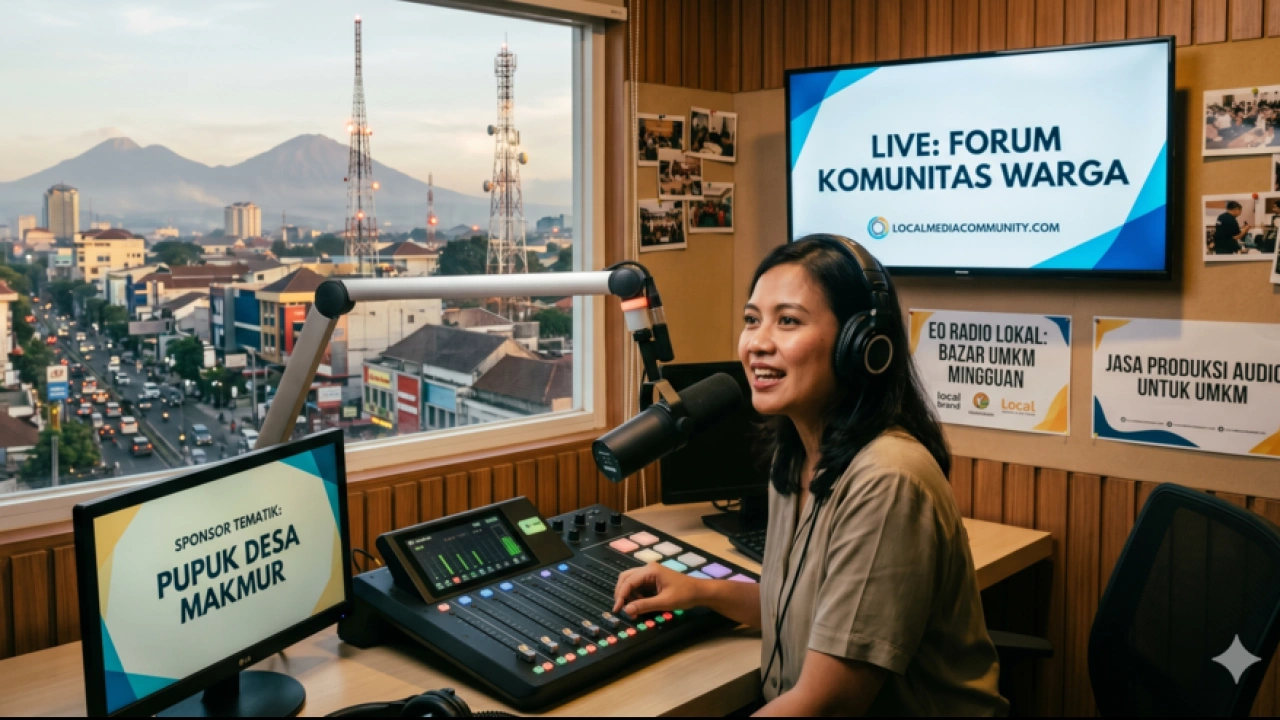
To continue to perform their functions, radio operators must boldly redefine their existence by returning radio to its roots: community closeness. Radio need not compete with global digital music platforms in terms of the breadth of its song catalog. Instead, radio must position itself as a center of citizen conversation or a hyperlocal community hub. This approach is realized by designing programs that specifically address real-world issues in the surrounding environment, from public services and commodity prices to the preservation of local culture. This loyal mass base is a valuable asset that opens up new market niches.
Simple Business Models
For small-scale radio stations in the regions, business innovation doesn't always require expensive digital technology investments. There are several simple business and monetization models that can be implemented immediately. First, radio stations can optimize their production space to become a local audio production house. Many Micro, Small, and Medium Enterprises (MSMEs), village government institutions, and even regional legislative candidates require quality audio assets—such as jingles, promotional podcasts, business profiles, or public announcements—to be distributed via social media or village loudspeakers. Radio stations, with their studio facilities and expert broadcasters, can rent out these audio asset creation services without requiring clients to purchase broadcast space on their airwaves.
Second, radio stations can expand their reach by taking on the role of community activation initiator or hyperlocal event organizer. Rather than passively waiting for advertisers, radio stations can organize small-scale, yet crowd-pleasing, in-person events, such as weekly MSME fairs, village harvest festivals, local musician appreciation stages, or weekend mass exercise events. Fresh revenue can be generated directly from bazaar booth rentals, sole sponsorships from local brands, and revenue-sharing collaborations with participating vendors.
Third, radio stations need to shift their sales strategy from simply offering short spot advertisements to integrated thematic sponsorship schemes. For example, a local agricultural equipment store or fertilizer factory would no longer simply purchase a thirty-second ad but would instead be encouraged to fully sponsor a one-hour talk show segment on effective farming tips. This B2B (Business-to-Business) partnership model is also highly relevant for Village-Owned Enterprises (BUMDes), community health centers, educational institutions, or non-governmental organizations (NGOs) that require an affordable communication medium that commands a high level of trust among local residents for their outreach programs.
Platform Convergence and the Future of Public Broadcasting
While hyperlocal business models are becoming the new backbone, digital technology must still be leveraged as a tool for convergence and distribution expansion. High-value and relevant broadcast content can be repackaged into on-demand audio formats (podcasts) to reach the regional diaspora, who now reside in urban areas with established internet connections. Through this convergence strategy, radio operators in various districts can implement a network syndication or Hub-and-Spoke model. This inter-radio collaboration will drastically reduce production operational costs while enabling regional issues to be elevated to the regional and national levels.
Ultimately, the recent wave of radio station closures should be interpreted as a natural selection process demanding the end of rigid, traditional broadcasting mindsets. Amid Indonesia's challenging geographical landscape, the existence of independent and down-to-earth public media is essential for fulfilling citizens' right to information, especially in remote areas. However, this noble journalistic ideal can only survive if supported by an economically adaptive operational foundation. As long as radio operators are astute in identifying community niches and creatively offering business solutions to their local ecosystems, their frequencies will never die off the air.
© 2026 SUARA.COM - ALL RIGHTS RESERVED.


