 Tue, May 26, 2026 12:17 AM
SEMARANG – The local media industry is facing a harsh reality: quality journalism is no longer enough to sustain itself amidst the onslaught of digital disruption and artificial intelligence (AI).
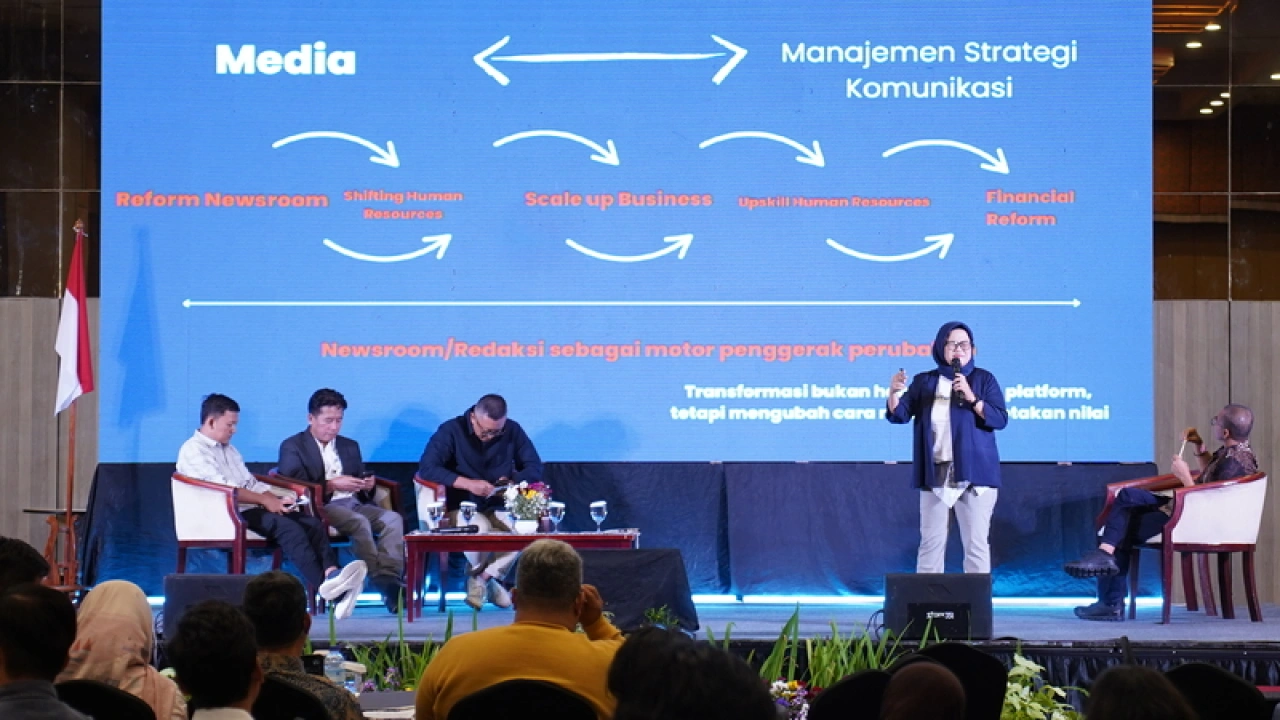
This crucial issue of media business sustainability was a major focus of the first discussion session of the Central Java Media Summit (JMS) 2026, held at the Khas Hotel in Semarang on Thursday (May 21, 2026).
With the overarching theme "A New Roadmap for Central Java Local Media," the forum brought together media leaders and experts to formulate survival strategies.
Suara.com's Editor-in-Chief, Suwarjono, bluntly stated that the old business model is obsolete.
"Journalism today can't finance the media, whereas in the past, news articles could," Suwarjono asserted in a session moderated by Pantura Post CEO Muhammad Irsyam Faiz.
According to him, the media currently faces a "triple disruption": technological disruption (especially AI and algorithms), demands for efficiency, and sustainability challenges.
He highlighted how AI is transforming content production and distribution, with media becoming the "feeder" for AI to maintain relevance in searches. On the other hand, reliance on advertising, including from the government, often stifles media independence.
The solution, according to Suwarjono, is building a solid business ecosystem. "If we can't fund journalism, we must have a media ecosystem to find the money to fund it. For example, when I founded Suara.com, the first step was to establish a PT (company) to finance journalism," he explained.
Similarly, Solopos Media Group's Editor-in-Chief, Rini Yustiningsih, acknowledged the tremendous pressure on editorial independence due to financial needs. Comprehensive transformation is key, not only within the editorial team, but also in finance and business.
"It's true that things are different now. We earn money for journalistic needs. The point is that the media needs to cover salaries and operational costs," Rini said.
She cited the example of Solopos rotating its team every three months for efficiency and requiring all human resources, without exception, to contribute to generating revenue (removing human resources without layoffs).
The Head of the Press Council's Digital and Sustainability Commission, Dahlan Dahi, reminded the media to understand how the internet and AI work as the primary channels for information distribution.
He outlined the fundamental shift from search engines to answer engines, keywords to prompts, and engagement to authority. The Press Council itself is highlighting the phenomenon of "homeless media" and encouraging them to demonstrate a clear identity.
Advertising practitioner Janoe Arijanto offered a different perspective. He sees the homogenization of content caused by algorithms as a threat. The solution is not to abandon platforms, but rather to build a "parallel media ecosystem" based on direct social relationships, trust, and strong communities.
"The closer the media is to its audience, the less dependent it is on the platform," Janoe emphasized.
According to him, audience loyalty and a strong community network are business foundations that are not easily shaken by changes in any platform's algorithm.
"Character, community, and trust are the foundations of media that cannot be easily replaced by algorithms," he concluded.
© 2026 SUARA.COM - ALL RIGHTS RESERVED.


