 Thu, Aug 13, 2026 12:28 PM
The media landscape is changing rapidly as audience behavior shifts, distribution platforms evolve and newsroom operating costs continue to rise. Against this backdrop, local media organizations are being urged to adapt quickly to ensure the sustainability of both journalism and their businesses.
Suwarjono, Editor-in-Chief of Suara.com, said the challenges facing the media industry will become increasingly difficult. He emphasized that collaboration among media organizations is essential to strengthen the industry's resilience amid sweeping changes.
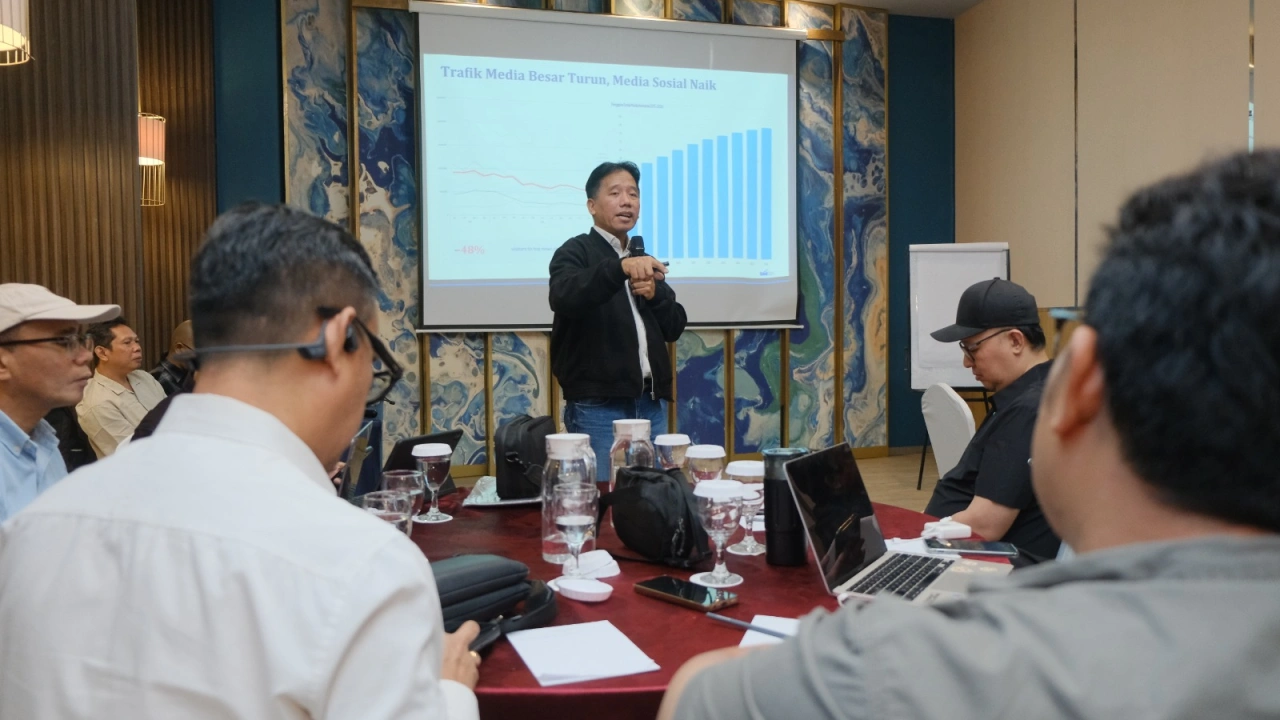
"The challenges ahead will be very difficult. That is why we are encouraging media organizations facing the same challenges to collaborate," Suwarjono said during a discussion titled "Media Sustainability and the Ecosystem" at the Local Media Summit in Makassar, South Sulawesi, on Wednesday (Aug. 12, 2026).
He said the transformation is occurring across the media ecosystem, from technology and audience characteristics to distribution platforms and content consumption patterns. Media organizations, he added, can no longer rely on traditional approaches as audiences rapidly change how they access information.
"Change is happening very quickly. Readers, platforms, technology and content are all changing. We have no choice but to go all out and change as well," he said.
Despite the disruption, Suwarjono stressed that journalism itself must remain at the core of the media industry. The challenge, however, is that conventional business models are becoming increasingly difficult to sustain newsroom operations.
News production costs continue to rise, while revenue from traditional advertising is declining. In the past, media businesses were generally able to finance their own operations. Today, that model is under increasing pressure.
"Journalism used to generate enough revenue to finance the newsroom and operations. Now it is expensive. Revenue is no longer sufficient to cover production costs, so journalism itself has to be financed," he said.
Financial independence is another major challenge for local media. Suwarjono said media organizations at the regional level remain highly dependent on local government budgets, with such funding accounting for as much as 90 percent of their revenue in some cases.
This dependence creates significant vulnerabilities as government spending cuts could reduce public-sector media budgets. Suwarjono warned local media operators not to assume that government funding would remain available.
"Be prepared for the possibility that some regions may no longer have budgets for media. This year's budgets are already smaller, and next year there may be none at all," he said.
Embracing Digital Platforms and Diversifying Revenue
At the same time, major changes in platform algorithms have put pressure on website traffic. Social media, meanwhile, continues to grow rapidly, particularly among Gen Z audiences, many of whom prefer consuming news through platforms such as Instagram and TikTok rather than visiting news websites directly.
Rather than treating digital platforms as competitors, Suwarjono encouraged local media to use them strategically for content distribution, audience acquisition and community building.
Revenue diversification is also essential. He recommended that media organizations develop at least three to four different revenue streams so that a decline in one source does not immediately threaten overall operations.
Suwarjono also highlighted local media's strongest competitive advantage: their proximity to communities and local issues.
He criticized the tendency among local outlets to produce similar stories, resulting in competition based primarily on speed and publication volume. Instead, local media should capitalize on their deeper understanding of local issues, figures, communities and culture.
"For example, there are 50 media outlets in Makassar, but 80 percent of their content is the same. That is why they struggle to grow unless their content is clearly different. National media find it difficult to compete on in-depth local issues, local figures and culture. Local media should become the official storyteller of the region," he said.
AI Adoption and Sharper Audience Targeting
The push for transformation and new business models was also reflected among local media operators attending the Makassar forum.
Toto Sudarmongi, who manages the Info Sulawesi news portal, said discussions on artificial intelligence (AI) provided new insights into improving newsroom efficiency.
He said AI tools could help streamline information processing while maintaining journalistic principles.
"Through the Local Media Summit, I gained a better understanding of how to modify and develop news with the help of technology, particularly NotebookLM. The interface is more engaging, the features are comprehensive and, in my view, it is easy to apply in daily newsroom work," Toto said.
He added that technological expertise, combined with a deeper understanding of audience characteristics, could create broader opportunities for collaboration, including with local governments, through more specific and community-based content.
A similar perspective came from Ibnu Munsir, who manages Info Kota Makassar. He said the forum gave him a new understanding of the importance of defining a specific target audience.
According to Ibnu, growth in digital media is not simply about producing large amounts of content. Building reader loyalty is equally important.
"From this discussion, I learned how important it is to identify the target audience. Once we know who our readers are, we can produce more relevant content and have greater opportunities to grow as a business," he said.
© 2026 SUARA.COM - ALL RIGHTS RESERVED.


