 Fri, Nov 6, 2026 5:17 PM
UNESCO and Mata Media Nusantara have trained 30 content creators and media representatives from various regions across Indonesia, including Bali, Central Java, East Java, North Sulawesi, West Java, and Greater Jakarta (Jakarta, Bogor, Depok, Tangerang, and Bekasi). The training aimed to strengthen participants' skills in verifying information, using artificial intelligence (AI) responsibly, and producing credible content for online audiences.
Digital content creators, including bloggers, podcasters, influencers, and independent media outlets, play an increasingly important role in shaping online narratives and public opinion. However, as AI becomes more widely used in content production, creators face growing challenges related to accuracy, credibility, and audience trust.
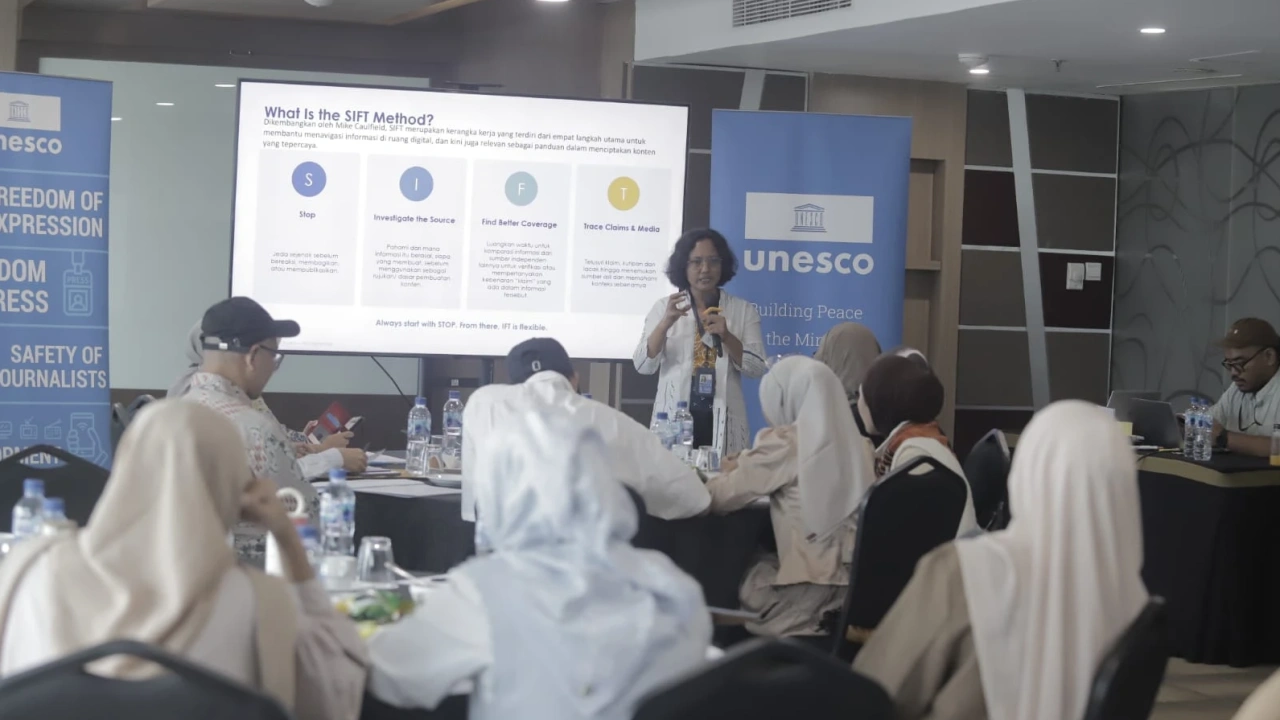
The initiative was delivered through a workshop titled Creating Trustworthy, Engaging, and Sustainable Content in the Age of AI, held as part of the 2026 Local Media Summit and Global Media and Information Literacy Week 2026.
Using UNESCO's Super Creators Toolkit, participants took part in practical exercises on information verification, responsible AI use, and ethical content creation. Based on the principles of Media and Information Literacy (MIL) for digital content creators, the training focused on producing trustworthy content in the age of AI.
Participants were introduced to the SIFT method, a four-step approach to evaluating online information: Stop, Investigate the Source, Find Better Coverage, and Trace Claims, Quotes, and Media to the Original Context. They also explored how content creators and local media outlets can combine their strengths in reporting, research, fact-checking, and digital storytelling to improve the quality and credibility of public information.
Throughout the workshop, participants attended sessions covering AI applications, information verification, and ethical considerations in content production. The sessions combined presentations with practical exercises to help participants understand how these principles can be applied to their everyday content creation activities.
Discussions and question-and-answer sessions also provided opportunities for participants to share experiences, raise questions, and address challenges they encounter when using AI to create and distribute content. Interactions between content creators and local media representatives further encouraged the exchange of knowledge on reporting practices, fact-checking, and presenting information in formats that are more accessible to digital audiences.
"Content creators have an increasingly significant influence on how people understand the world around them. As AI becomes part of everyday content production, this influence comes with greater responsibility to ensure accuracy and credibility. Creators need the skills to question what they see, verify information, and make informed decisions about what they share," said Maki Katsuno-Hayashikawa, Director of the UNESCO Regional Office in Jakarta.
Meanwhile, Suwarjono, President Director of Mata Media Nusantara, highlighted the challenges that information disorder and the growing use of AI pose for content creators and media practitioners.
"Today, content creators operate in an increasingly complex information environment. The rapid spread of misinformation and disinformation, combined with the growing use of artificial intelligence, requires creators to strengthen their media and information literacy skills, verify information more rigorously, and uphold ethical standards when producing and sharing content. These competencies are essential to maintaining public trust and ensuring that digital platforms contribute positively to an informed and democratic society," Suwarjono said.
The initiative also seeks to encourage continued collaboration between local media outlets and content creator communities. Through such partnerships, local media can contribute reporting, research, and fact-checking expertise, while content creators can transform information into formats that are more accessible, engaging, and relevant to digital audiences.
Through this initiative, UNESCO and Mata Media Nusantara aim to contribute to a more inclusive, resilient, and trustworthy information ecosystem while strengthening the capacity of local media and content creators to uphold reliable information and integrity in the age of artificial intelligence.
© 2026 SUARA.COM - ALL RIGHTS RESERVED.


